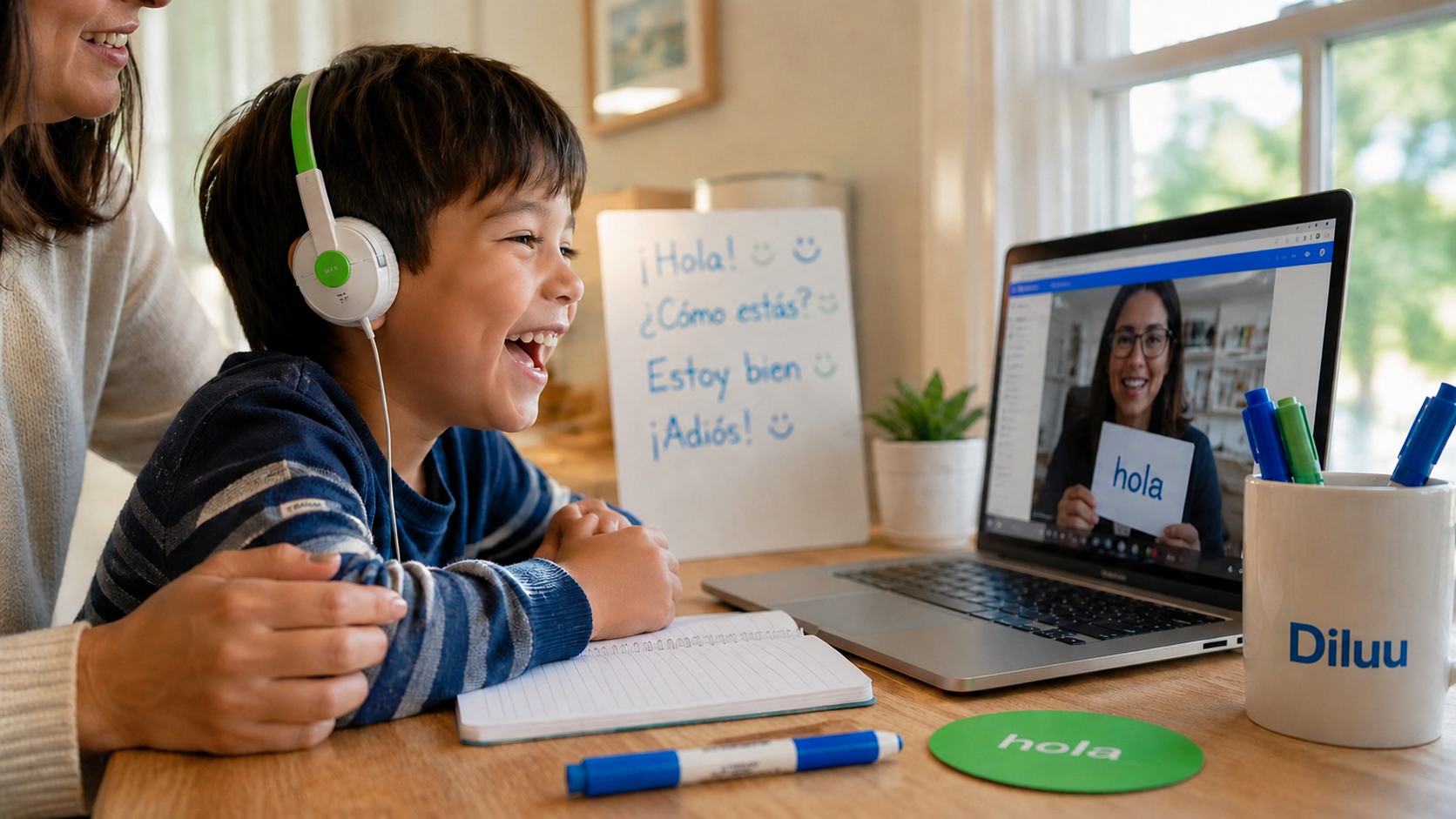
Before you sign your child up for anything new, you want to see it with your own eyes. Completely fair. That is the entire reason the trial class exists: one real class, low stakes, so you can watch how your child reacts before you decide a single thing.
Here is exactly how it goes, start to finish, what it costs afterwards if you carry on, and how to book a slot in about a minute.
One real class, €3 (about $4)Pick a time that suits you, we send the Zoom link. No subscription starts unless you choose to begin one.
The short version
- The trial is a real group class of 30 or 45 minutes with a native teacher, not a sales call or a test.
- It costs €3 (about $4) so the children in that first class are genuinely there, and your child gets a proper group from minute one.
- Booking takes about a minute: choose a slot, tell us your child's age and level, pay, done.
- Afterwards you get honest feedback on your child's level and the format that suits them.
- If you carry on, group classes work out at roughly €9 to €11 a class, billed every four weeks, with no contract. See the prices in your currency.
Why it costs €3 and is not free
Let us deal with this first, because it is the question everyone has. A €3 trial, about $4 in the US, is not a money-maker. It barely covers anything. It is there to do one job: make sure the children in that first class actually showed up to learn.
Free trials sound generous, but they fill the room with people who booked on a whim and never log in. Your child ends up in a half-empty class with no real group around them, which is the opposite of what makes a Diluu class work. Three euros is small enough that it stops nobody who is genuinely curious, and just enough to keep the room full of families who mean it.
So the price is not a hurdle. It is what makes your child's first class a proper one. Think of it as the cost of a coffee to find out something that actually matters.
How to book it, step by step
The whole thing happens on one page and takes about a minute. Nothing to install, no account to create first.
- Pick a day and timeThere are slots across time zones, so wherever you live something fits. You will see the times in your own time zone, and weekends and after-school hours are included.
- Tell us about your childTheir age, and roughly how much Spanish they have: none at all, understands but does not speak, or already speaks a bit. That is what lets us put them in a trial pitched at their level instead of a generic one.
- Pay the €3 and check your inboxYou get the confirmation and the Zoom link by email straight away. Add it to your calendar and that is it until class time.
Ready when you areChoose a slot now, or come back to this page later. The booking form opens right here, without leaving the article.
Before the class
Your child's level can be anywhere on the map and it is all fine. Maybe they understand everything and clam up, which is the classic heritage speaker pattern. Maybe they speak a bit and muddle it. Maybe they barely have any Spanish at all, which is the most common starting point of all. We aim the class accordingly, so it is never so hard they shut down or so easy they switch off.
What you needA computer, tablet or phone with a camera, and the Zoom link we send. Nothing to install, nothing to print.
How long it lastsThe same as a normal class: 30 minutes for the youngest, 45 for older children.
Who else is thereOther children at a similar level. Groups go up to six, and up to four for beginners and for ages 4 to 6.
During the class
Your child meets a native-speaking teacher in a live class. This is not a test or an interview. It is a real class, with games and conversation, built so they loosen up and enjoy themselves. The teacher is quietly reading three things: what your child understands, what trips them up, and how they warm to speaking. By the end she has a clear sense of where they sit.
You are welcome to sit nearby, especially if your child is little or shy. Many parents do for the first one. But the idea is for your child to be the one in the spotlight, talking to the teacher rather than to you.
A kid who starts the class half-hiding behind a shoulder usually ends it laughing. That shift, in one short class, tells you more than any sales page could.
What it actually feels like
Picture a typical one. A six-year-old joins with his mum just off to the side, arms crossed, deciding he is not going to talk. The teacher does not push. She waves a puppet, asks a question in Spanish with a big gesture so he gets it without translation, and waits. Two minutes later he is pointing at the screen. Five minutes after that he is shouting an answer over the other kids. By the end he is asking if there is another one tomorrow, and his mum is the one sitting there a bit stunned.
It does not always go that fast. But that arc, wary to grinning, is the single most common thing parents report from a trial, and it is the reason we would rather you watch one than read about it.

After the class
We tell you honestly how it went: roughly what level your child is at, whether a small group or one to one would suit them better, and how the schedules would work for your week. No pressure to decide on the spot, no hard sell. The point is simply that you now have the information to choose calmly, and if Diluu is not the right fit, we would rather you knew that too.
What you will know by the end
In about half an hour, you will have answers to the questions that actually decide this:
Four answers for the price of a coffee
- Does my child engage with a live teacher on a screen, or tune out?
- Roughly where are they: beginner, understands but will not speak, or further along?
- Do they enjoy it enough to come back without a fight?
- Does a small group or one to one make more sense for them?
That is far more than you would get from reading reviews or watching a promo video.
What it costs if you carry on
No surprises waiting on the other side. Plans are billed every four weeks and get cheaper per class the more days a week your child joins. There is a sibling discount, no joining fee and no contract, so you can stop whenever you like. Here are the current prices, in your currency:
Prices per class
Pick group or private, how often you pay, and your currency.
- 1 class per week
- Live with native teachers
- Home activities included
- 2 classes per week
- Faster, steadier progress
- Events and pen pals
- 3 classes per week
- True immersion rhythm
- Everything included
Official Diluu price list · prices per class, in your currency. Sibling discount, no joining fee, no contract. Billing is handled securely at checkout.
Comparing options? Read how much online Spanish classes for kids cost.
A few tips to get the most out of it
Small things that help the trial go well:
Before you press join
- Do not over-prepare your child. No need to warn them it is a "Spanish test", that only builds nerves. "There is a fun class with a teacher and some other kids" is plenty.
- Pick a time they are fresh, not right after school when they are fried. A rested child shows you their real reaction.
- Sit out of the camera's eye if you can. Kids perform for parents, so let them talk to the teacher instead.
- Resist translating for them. If they get stuck, let the teacher handle it. That is exactly the skill you are there to watch.
- Watch their face, not their grammar. Whether they are enjoying it tells you far more in a trial than how many words they get right.
The tell that matters most: at the end, do they ask when the next one is? That question is worth more than any level report.
A few quick questions
How long does the trial class last?
The same as a normal class: 30 or 45 minutes, depending on your child's age and level.
How many children are in a trial class?
It is a real group class, so your child sits with other children at a similar level. Groups go up to six, and up to four for beginners and for the 4 to 6 age group. Literacy classes are one to one.
Do I have to stay on the call?
With younger or shyer children it helps to be nearby for the first one. Older children often do better on their own. Your call.
What if my child barely speaks Spanish?
That is the most common starting point of all. The trial is pitched so a true beginner follows along from the first minute, through gestures, games and repetition rather than translation. Here is how a class actually works.
Is Zoom safe for my child?
Yes. Each group gets its own private link and password, cameras and microphones stay in your control, and only the teacher and the children in that group can join.
What do we need for the class?
A computer, tablet or phone with a camera, an internet connection and the Zoom link we send you. Nothing to install and nothing to print.
What if something comes up and we cannot make it?
Tell us before the class at info@diluu.com or on WhatsApp and we will move you to another slot. Life with children happens.
What does it cost if we carry on?
Group classes work out at around €9 to €11 a class depending on how many days a week your child joins, billed every four weeks. There is a sibling discount, no joining fee and no contract. See the full price table above.
What if we decide it is not for us?
Then it cost you €3 and an afternoon, and now you know. No subscription starts unless you choose to begin one.
Book your child's trial class
It is the smallest step and the one that clears up the most doubt. One real class, €3 (about $4), a native teacher and a handful of children the same age.
New to Diluu? Here is the full picture first, or meet the teachers.