French classes for kids aged 10–12: real conversation, real friends
This is the age when French stops being a class and becomes something of their own: debates, creative projects and proper conversation with native teachers and classmates from 56 countries. Groups of maximum 6 children (4 when they start from scratch). Part of our online French classes for kids.
Book a trial class · €3★★★★★ More than 300 families have given us 5 stars
Should homework exist?
Live now · 30 seconds each to convince the group

 Je ne suis pas d'accord !
Et toi, qu'en penses-tu ?
Attends, attends !
Je ne suis pas d'accord !
Et toi, qu'en penses-tu ?
Attends, attends !
What a class looks like at this age
Thirty or forty five minutes, depending on their level, talking about things they actually care about. No colouring sheets and no cartoon vocabulary: at 10, 11 and 12 the content has to be worth their time, so the class runs on debates, role play, team projects and a fair amount of humour. French is not the subject here, it is what they use to win the argument.
-
A debate with two sides
Homework, school uniforms, phones at the table, the best film of the year. Everyone gets a side to defend, and the group decides who was most convincing.
-

A role with a problem to solve
A journalist in a press conference, a guide showing a city, a witness in a strange case. Taking a role is still the easiest way to say something difficult out loud.
-
A creative project, in teams
A podcast episode, a fake news bulletin, a travel plan with a budget. They build it across a few weeks and present it in French to the rest of the group.
Meet the native teachers who run these classes.
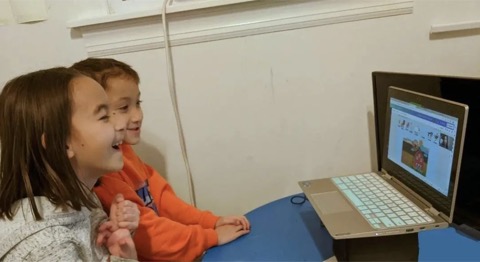
30 or 45 minutes, live
A real class, seen from home: debates, roles and projects in French.
The best age to learn, and the shyest age to speak
Between 10 and 12, tweens can move faster than at any other age: they concentrate for longer, they know more about the world and they have plenty to say about it. The same years bring the fear of sounding silly in front of other people. That is why groups are small and formed by age and by level, and why getting it wrong is part of the game.

They can go fast now
A preteen brain does in one term what a five year old needs a year for: they hold attention for longer, they already know how a language is put together and they ask why. Complete beginners start in a group of maximum 4, with guided immersion and everything supported by pictures, objects and gestures.
And they hate getting it wrong in public
Nobody feels watched like a 12 year old. So the group is small, everyone is the same age and the same level, and the teacher corrects without stopping the conversation. In a class of six, nobody can hide, and nobody has to perform either.
Understands at home, but will not speak it
The most common case we see at 10 to 12. Your child is not a beginner: they need a place where French is the normal language and other children their age to use it with. That is what French for heritage speakers is for.
Year by year, in detail
Ten and twelve are two very different ages, even if both land in the same middle school years. This is what a class looks like at each one, and what changes along the way.
French classes for 10 year olds
At ten they learn faster than they ever will again: attention lasts longer, they already know how their own language works and they want to know why French does things differently. Debates start small, with clear rules: thirty seconds each, one argument at a time, and the group votes at the end.
Nobody gets put on the spot. Groups are small and formed by level as well as by age, so a beginner never sits next to someone who has spoken French for years, and complete beginners start in their own group of maximum 4. And because classmates join from other countries, the first friendships in French happen right there in class.
Mini-debates with rulesFrench for 11 year olds
At eleven French starts to become their own. They pick the topics of conversation: football, a series, the game everyone is playing, and the teacher builds the class around what the group actually wants to argue about. They prepare a position, defend it and take questions from the other side.
Children who hear French at home consolidate grammar here through use, not lists: nobody memorises verb tables, they use the past tense until it comes out right. Saying it well starts to matter to them, which is exactly when correction works best.
Their own topicsFrench classes for 12 year olds
At twelve the debates are real ones, with preparation, rebuttals and a conclusion, and theatre arrives: scripts they rehearse and perform for the group. It is our answer to the age when motivation can dip: the content has to be worth showing up for.
After a year of speaking French every week, a twelve year old can hold a thirty-minute conversation about something that matters, present a project they wrote themselves and act out a scene without reading it. That is what they leave with: a French they use, not one they revised.
Real debates and theatreFamilies in every time zone
Understands everything, but is embarrassed to speak it?
At 10 to 12 this is the most common thing we hear. It is not a level problem: it is the age. Small groups, children their own age and French as the normal language of the room.
 French for heritage speakers →
Reading, scripts and spelling: Reading & Theatre
At 10 to 12 the group levels of Reading and Theatre are the perfect companion to the weekly French class. They read out loud in French, they learn scripts and they perform them, and spelling and the harder bits of grammar arrive through use rather than through rules.

Fluency and confidence
For children who already read in French but still stumble. Longer texts, reading out loud until it sounds like speaking, and their first paragraphs written without help.
Literature, scripts and advanced grammar
Real stories and plays, scripts they rehearse and perform, and the spelling and grammar that only matter once you are writing something you want other people to read.
Not reading in French at all yet? They start with the one-to-one French literacy course and move into these levels afterwards.
What families of 10 to 12 year olds say
"I'm French and I've lived 18 years in Croatia; I have 2 children with my Croatian spouse. My children could speak French very well but didn't know how to read and write. I recommend Diluu: after a year of just 30 min a week, my children now know how to read in French."
"Diluu's courses are perfect for children you want to raise in a bilingual environment. We've been attending their French classes for over a year and our son has made remarkable progress. Thank you, Diluu!"
"This is a great platform. My daughter is taking the French classes with Miss Anne and she's improving big time. Recently she moved up to the next level, and she's up to the challenge. I would 100% recommend this platform if you want your kid to learn a second or third language."

"We've had a great experience with Diluu for our children. The French lessons are engaging, well-structured, and adapted to each child's level. A special thank you to Morgane, an outstanding teacher: warm, encouraging, and truly great with kids."
"We couldn't recommend them more. The teachers are amazing and go above and beyond. My children learnt Spanish before with Lucila, and we're now learning French with Morgane, who is incredible. The progress showed from day one!"
"Very satisfied with these online French lessons! My daughter loves her sessions and has gained a lot of confidence speaking French. What pleasantly surprised me was the regular follow-up with parents to keep me informed of her progress."
★★★★★ 5.0 from 300+ reviews · Read more reviews from families
FAQs about French classes for 10 to 12 year olds
Is 10 or 12 too late to start French?
Not at all. At 10, 11 and 12 children learn faster than ever: they concentrate for longer, they already understand how a language works and they want to know why things are said that way. Complete beginners start in their own group of maximum 4 children, with guided immersion (the Total Physical Response method), so everything the teacher says comes with pictures, objects and gestures and nothing has to be translated.
My child is shy. Will they have to speak in front of everyone?
The group is small on purpose: a maximum of 6 children, all the same age and the same level, and a maximum of 4 in beginner groups. Nobody is marked and nobody performs for the class: speaking happens inside games, debates and roles, where getting it wrong is part of playing. Shy children usually start talking because the group is too small to hide in and too friendly to fear.
We speak French at home. What will my child get out of it?
A place to use it with other children, which is what most home bilinguals are missing. Grammar consolidates through use: instead of memorising rules, they argue, tell stories and present projects until the right forms come out on their own. Our French for heritage speakers page explains how we work with these families.
What is Reading & Theatre?
Our group levels for children who already read and write in French, from age 7, in small groups of maximum 6. Level 1 builds fluency and confidence reading out loud; level 2 moves into literature, scripts they rehearse and perform, and the spelling and grammar that matter once you write for other people. If your child cannot read in French yet, they start with our one-to-one French literacy course and move into these levels afterwards.
What happens after 12?
Diluu is built for children aged 4 to 12, so we do not run secondary school courses or exam preparation. What a child leaves with at 12 is French they can actually use, and many carry on with us in Reading and Theatre.
How do the classes work?
One class a week, live: 30 minutes in beginner groups and 45 minutes at higher levels, with a native teacher from France. We have classes from Monday to Sunday across every time zone, and you start with a €3 trial class with no commitment.
Before and after this stage
Their Spanish keeps growing with them.
Not quite 10 yet?
Between 7 and 9 the class runs on missions, role play and the first real conversations in French.
French classes for kids aged 7–9 →
And after 12?
Diluu is built for children aged 4 to 12, so we do not run secondary school courses or exam preparation. What a child leaves with at 12 is French they can actually use, and many carry on with us in Reading and Theatre.
See everything we do in French →Younger brother or sister at home? There is also a group for 4 to 6 year olds, where the method is pure play.
One class is all it takes to hear them argue in French
Thirty or forty five minutes, €3, no commitment, with a native teacher and a small group of children their age.
Book a trial class · €3Not sure yet? Read our guide to online French classes for kids.